
Defense Manufacturing Returns
America is pouring concrete for shipyards and shell plants again. The hard part isn't the money — it's everything money can't rush.
Bottom Line Up Front
For the first time since the Reagan years, America is building defense factories again — shell plants in Texas, submarine supplier expansions across the industrial Midwest and South, billions committed to shipyard capacity.
The money is real and bipartisan. The Navy's latest budget put roughly $5.8 billion into the maritime industrial base in a single year, and munitions plants have been funded across a dozen states.
The output is running behind the money — sometimes embarrassingly so. A nearly half-billion-dollar Texas artillery plant produced zero usable shells in its first two years. The Army's 155mm production goal has slipped repeatedly.
The reason is consistent everywhere: modern manufacturing capacity is a system of machines, qualified processes, and skilled people, and only the machines can be bought quickly.
That makes this a long cycle, not a news story. And long cycles reward anyone patient enough to track deliveries instead of announcements.
The half-billion-dollar lesson from Mesquite
In 2024, the Army opened a gleaming new artillery plant in Mesquite, Texas — the Universal Artillery Projectile Lines facility, built for about $469 million to mass-produce the steel bodies of 155mm shells. It was the centerpiece of the plan to push American shell production toward 100,000 rounds a month.
Two years later, government watchdogs delivered the verdict: the plant had yet to produce usable components. As of this spring, monthly national output was still sitting in the mid-30,000s — years behind the goal — and General Dynamics announced it would spend $200 million of its own money to get the Texas lines actually running.
Here's the thing: nobody stole the money, and the machines exist. What Mesquite reveals is harder and more interesting. A munitions line isn't "built" when the ribbon is cut. Every process has to be qualified — proven, batch after batch, to produce shells that won't blow up the gun crew firing them. New workers have to learn trades that barely exist in the civilian economy. The concrete is the easy part.
Ships are the same story, at ten times the size
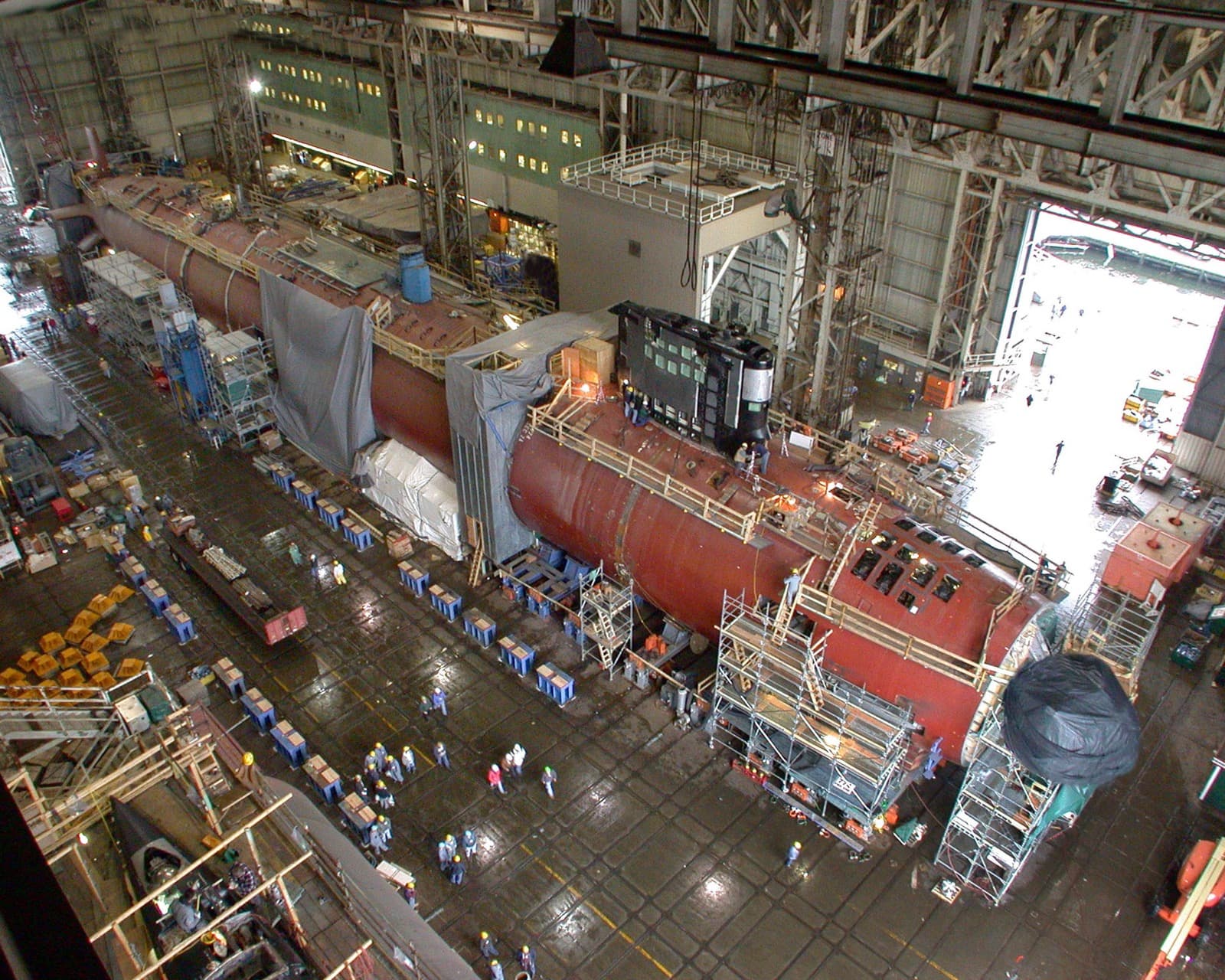
Translate that lesson to shipbuilding and the stakes get bigger. The Navy needs to build one Columbia-class ballistic-missile submarine plus two Virginia-class attack submarines every year. Actual delivery rates have run well below that for years, because the yards and their thousands of suppliers can't yet produce at that tempo.
So the money is going down the supply chain. The Navy's shipbuilding plan now reads as much like an industrial policy document as a fleet design: billions per year for supplier development, workforce pipelines, and advanced manufacturing. Deals like Rhoads Industries' ten-year, $2.5 billion agreement to support Electric Boat's submarine work show what the rebuild actually looks like — not one giant yard, but a lattice of fabricators being scaled up around it.
The geography is worth watching too. This buildout is landing in specific places: shell plants in Texas and the old arsenal towns of the Midwest, rocket-motor and missile capacity in Arkansas and Alabama, submarine suppliers spread from Connecticut down through Virginia and across the Rust Belt, drone factories in Ohio. Each facility drags housing demand, wage pressure, and community-college welding programs along with it. Defense budgets are quietly becoming regional economic policy.
And the workforce is the binding constraint under all of it. The submarine industrial base alone estimates it needs on the order of a hundred thousand new skilled workers over a decade — welders, machinists, electricians — recruited from a labor market that spent forty years telling young people not to do those jobs. Follow the chain: geopolitics sets budgets, budgets fund factories, factories collide with the trades shortage, and the shortage drives up wages and pulls in automation. That last link connects defense directly to the broader industrial-labor story playing out across the economy.
A cardinal builds its nest one twig at a time, and no amount of urgency changes the method. Industrial capacity gets rebuilt exactly the same way, which is why it keeps disappointing people who fund it like software.
Key Judgments
- Defense manufacturing capacity will keep expanding through the decade regardless of which party holds power — the funding coalition is durable even when execution embarrasses it.
- Delivery rates will keep lagging announced goals by two to four years across munitions and shipbuilding; the gap between press release and qualified output is structural, not managerial.
- Skilled labor, not capital, is the binding constraint — expect defense wages for welders and machinists to keep outrunning manufacturing averages, and automation investment to follow.
Risks & Counterarguments
The bear case has teeth. First, Mesquite might be the pattern, not the exception — you can fund capacity and still not get it, and every year of slippage invites Congress to redirect money toward drones and software that promise faster results. Second, demand could soften: a settlement in Europe, or a strategy that genuinely swaps munitions mass for autonomy, would strand some of this new capacity. Third, cost inflation is real — shipyard labor and materials costs are rising fast enough to eat part of every appropriation before it becomes steel.
The counter to the counter: the same slowness that delays this buildout also protects it. Half-built plants and trained workforces are politically very hard to abandon.
Why It Matters
Where factories rise, everything follows — jobs, wages, housing, suppliers, and eventually political constituencies that keep the money flowing. This is one of the few multi-decade capital cycles in the American economy that's publicly documented in advance, line by line, in budget justification books anyone can read. Most industrial stories make you guess at demand. This one publishes it.
What We're Watching
- Monthly 155mm output versus the 100,000-round goal, and whether General Dynamics' Texas rescue actually ships qualified shells.
- Virginia-class delivery cadence: any sustained move toward two boats per year is the single clearest signal the maritime rebuild is working.
- Shipyard and munitions workforce data — hiring, attrition, and wage growth at the big yards and their suppliers.
- Whether industrial-base line items survive intact through the next budget cycles, or start losing ground to autonomy programs.
Sources: Office of the Under Secretary of Defense (Comptroller) budget justification books; U.S. Navy Shipbuilding Plan (2026); Department of Defense Inspector General and GAO reporting on 155mm production; U.S. Army procurement announcements; contractor disclosures. This is analysis, not investment advice.