
The New Industrial Base
Beneath every missile and submarine sits an invisible economy of foundries, chemical plants, and small machine shops — and it's being rebuilt across three continents at once.
Bottom Line Up Front
Ask where a missile comes from and most people name a famous company. The truer answer is a chain of unfamous ones: a foundry that casts the fins, a chemical plant that cooks the explosive fill, a mill that forges the motor case, a shop that winds the guidance cables.
That hidden layer — castings, forgings, energetics, specialty electronics — is where Western rearmament actually succeeds or fails. And after decades of consolidation, parts of it are one facility deep.
The rebuild has begun, and it's taking a distinctive shape: defense-specific investment in the true chokepoints, dual-use capacity borrowed from the commercial economy everywhere else, and — the newest piece — allied co-production, with countries like Australia building missile and rocket-motor plants tied into American programs.
This isn't the broad reshoring wave we've covered elsewhere. It's narrower, slower, and more deliberate: a supply chain rebuilt for the specific things that explode, float, and fly.
The result, if it works, is something the Pentagon hasn't had since the Cold War — depth. Not just factories, but factories behind the factories.
Anatomy of a missile
Take an ordinary precision missile apart on paper and follow each piece home.
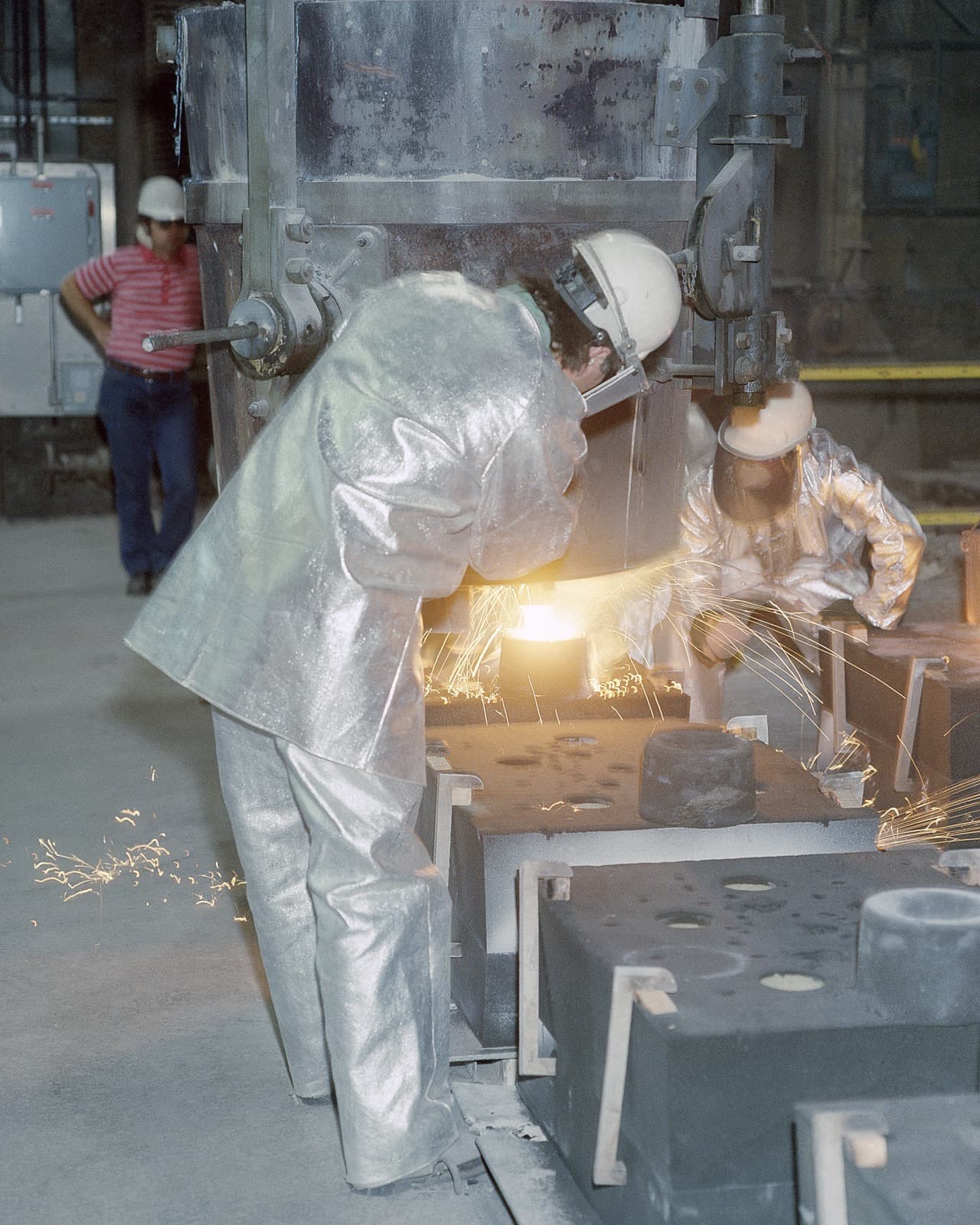
The body and fins trace back to castings and forgings — metal poured or pressed into shape at foundries. America had thousands of foundries in the 1980s; decades of offshoring closed a large share of them, and the survivors skew old, small, and family-owned. Some aerospace-grade castings now have exactly one or two qualified domestic sources, which means one fire, one retirement, or one failed inspection can stall a billion-dollar program.
The warhead and the rocket motor run on energetics — the propellants and explosives that make the whole thing more than an expensive dart. Most American military explosives flow through a handful of government-owned, contractor-operated plants, some with roots in World War II. Single-source ingredients are common. It's the classic pattern we documented in The Arsenal Gap, and it's why energetics money now shows up as a distinct line in budget documents.
The motor itself comes from a solid-rocket-motor industry that consolidated to essentially two major producers — which is why a wave of new entrants is now being funded to break the duopoly.
None of these companies hold press conferences. All of them can stop a program cold.
Dual-use and the allies: the two escape valves
Rebuilding every link from scratch would take decades, so the new industrial base is leaning on two shortcuts.
The first is dual-use manufacturing — capacity shared with the commercial economy. A drone maker buying motors, batteries, and circuit boards lives mostly in the commercial electronics supply chain. Shipbuilding suppliers welding submarine modules also serve energy and heavy industry. New defense factories are deliberately built like commercial plants — flexible lines, standard processes — so the same walls and workers can switch products as demand shifts. The advantage is speed and surge capacity; the risk is that "commercial supply chain" has too often meant "Chinese supply chain," which is exactly what current policy is trying to unwind.
The second escape valve is allies. Australia's Guided Weapons and Explosive Ordnance enterprise — a decade-long program in the tens of billions of Australian dollars — is standing up domestic missile assembly and, with Northrop Grumman, solid-rocket-motor production at the Mulwala munitions site, feeding the same weapons families America fields. Australian-assembled GMLRS rockets and locally tested warheads have already happened. Europe is running parallel plays on artillery shells and air defense. Co-production spreads the industrial risk across geography, adds allied money to the same programs, and — not incidentally — puts magazines closer to the theaters where they'd be used.
Follow the chain and it runs straight through the rest of the economy: energetics plants are chemical plants, competing for the same engineers and feedstocks; foundries are energy-hungry and labor-starved; every co-production deal is also a trade and alliance-politics story. The defense industrial base isn't beside the civilian economy. It's woven through it.
The visible part of a forest is the trees; the resilience lives in the root network underneath, fungal threads quietly moving nutrients to wherever the stress is. So it is with arsenals.
Key Judgments
- Sub-tier suppliers — castings, forgings, energetics, motors — will outgrow the prime contractors' own revenues in percentage terms through the decade, because they're growing off a starved base.
- Single-source chokepoints will cause at least a few high-profile program delays in the next several years; the map of those failures will direct the next round of investment.
- Allied co-production is durable across political cycles — it's one of the few defense policies that saves money, adds capacity, and strengthens alliances simultaneously.
Risks & Counterarguments
Qualification is the killer: in defense, a new supplier isn't a supplier until its parts pass testing that can take years — so announced capacity routinely arrives late or never. Allied co-production has its own failure mode: every country wants sovereign capability, which can fragment scarce engineering talent and money across duplicative half-scale plants. And if the autonomy thesis fully wins — cheap drones over exquisite missiles — some of this rebuilt capacity will be aimed at the wrong products. Finally, demand is policy-dependent: a genuine peace in Europe would test how much of this spending survives its first budget fight.
Why It Matters
Wars are won by the side that can keep producing, and markets systematically misprice the boring companies that make production possible. The visible defense economy — the primes, the platforms — is analyzed to death. The invisible one is not, and it's where both the strategic risk and the growth actually concentrate. Learning to see the layer beneath the famous logos is one of the highest-return habits in defense analysis.
What We're Watching
- Energetics and castings line items in Pentagon industrial-base budget documents, and whether funded expansions reach qualified production.
- Solid-rocket-motor competition: whether new entrants win real program awards or the duopoly holds.
- Australian GWEO milestones — locally produced GMLRS at scale, and rocket-motor production timelines at Mulwala.
- Rules on Chinese content in defense supply chains, which set the pace and cost of the whole dual-use strategy.
Sources: DoD Industrial Base Policy reports and comptroller budget justification books; GAO and Congressional Research Service reporting on the defense industrial base; Australian Department of Defence GWEO announcements; service procurement documents. This is analysis, not investment advice.