
Digital Healthcare Is Just Beginning
Healthcare bought computers fifteen years ago and got almost no productivity out of them. Here's why that's finally starting to change.
Bottom Line Up Front
American healthcare didn't skip the computer age. It bought in heavily around 2009, when federal subsidies pushed hospitals onto electronic records almost overnight. What it never got was the payoff. Records went digital; the work didn't get easier. Doctors ended up typing more, not less. That gap between "digitized" and "more productive" explains why so many well-funded health tech companies died trying to close it.
Three things are changing now. Telehealth quietly became a line item Congress keeps renewing. Ambient AI that listens to a visit and writes the note is the fastest-adopted use of generative AI in medicine. And payment is shifting from volume toward outcomes.
Be careful here. The history is a graveyard — Babylon Health, Olive AI, IBM's Watson Health unit, the Amazon-Berkshire-JPMorgan venture Haven. All promised transformation. All delivered write-downs.
The difference this time is boring, which is why it's more credible. The tools gaining ground don't replace doctors. They remove paperwork from doctors who are already scarce.
The industry that still runs on fax
Walk into almost any American hospital in 2026 and you'll find a fax machine, plugged in, doing real work. Referrals, prior authorizations, records requests from the specialist across town.
Banking abandoned paper. Retail abandoned paper. Healthcare bought tens of billions of dollars of subsidized software and kept the fax. Follow the money, because in healthcare money explains nearly everything.
Most American care is still paid on fee-for-service. Translated: providers get paid per thing done. Per visit, per scan, per procedure. Never per problem solved, and never per hour of clinician time saved.
Now think about what that does to technology. Invent something that lets a clinic see the same patients in less time and you haven't created a windfall — you've just done the billable thing faster. Every dollar your software saves the insurer is a dollar somebody else stopped earning. Add rules that make moving data between competitors legally fraught, and you get an industry with enormous incentive to digitize records and none to digitize workflows.
Healthcare didn't resist computers. It resisted the part of computing that makes an industry cheaper, because nobody in the room got paid to want that.
What's actually different now
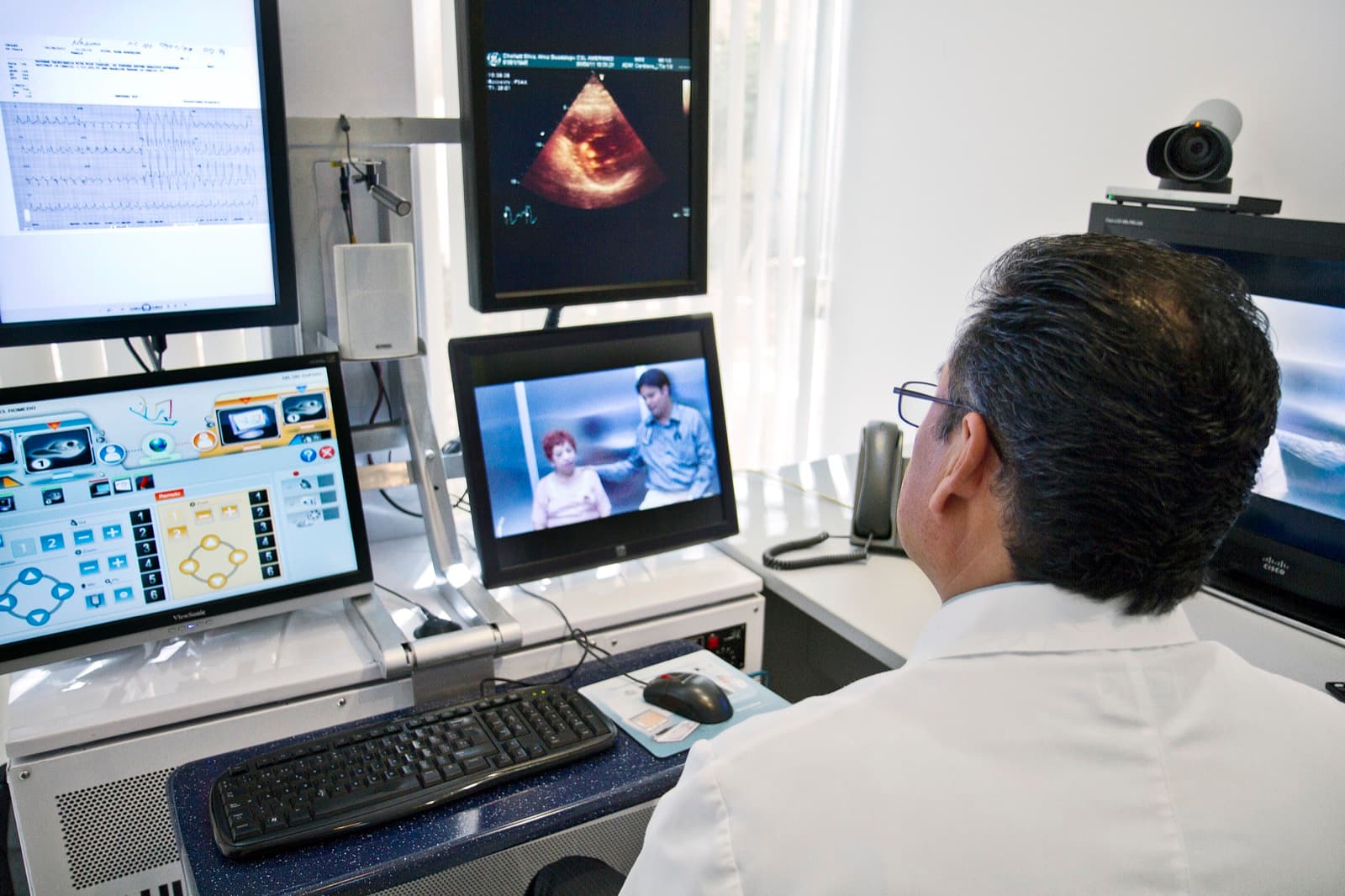
Telehealth is the cleanest test. Virtual visits spiked during the pandemic, then collapsed, which convinced a lot of people the category was a fad. It wasn't. It settled. FAIR Health, which tracks a large national database of private claims, put telehealth at 5.51% of medical claim lines in the first quarter of 2026, up from 5.01% the prior quarter. That's a floor, not a spike. And it's concentrated: mental health is roughly two-thirds of telehealth claim lines. Telehealth didn't replace medicine. It found the specialties where a camera is as good as a room.
Policy matters just as much. Medicare's pandemic-era flexibilities were extended repeatedly on short leashes, sometimes weeks at a time, which made building a business nearly impossible. The Consolidated Appropriations Act of 2026 pushed the major ones to December 31, 2027, and hospital-at-home to September 30, 2030. Multi-year visibility turns a pilot into capital investment.
Then there's documentation. Physicians spend an enormous share of the day writing notes, much of it after hours. Ambient AI scribes listen and draft — a narrow use case, which is exactly why it works. Studies published in JAMA Network Open in 2025 found real gains: Mass General Brigham reported a 21.2% absolute reduction in burnout prevalence after 84 days of use, across a study of more than 1,400 clinicians run with Emory Healthcare. Kaiser Permanente ran over 2.5 million encounters through AI scribes across roughly 7,260 physicians in 14 months.
Notice what it doesn't claim. It doesn't diagnose. It doesn't decide. It gives time back to a workforce the country is short of. Same pattern as enterprise AI everywhere: what sticks targets the paperwork around expert judgment, not the judgment.
Cardinals don't migrate. They stay through the winter and change what they eat instead. Health technology works the same way. The systems that survive aren't the ones that promised to replace the ecosystem. They're the ones that adapted to what the payment system was willing to feed them.
Which brings us back to payment. CMS approved 511 accountable care organizations in the Medicare Shared Savings Program for 2026, and value-based models keep expanding even as individual experiments end — ACO REACH winds down after 2026, with a successor, LEAD, starting January 2027. When a provider owns total cost of care rather than volume, technology that keeps someone out of the hospital finally becomes an asset instead of a cost.
Key Judgments
- Telehealth has stabilized as a durable slice of care concentrated in behavioral health, not a substitute for in-person medicine.
- Ambient documentation AI is the first mainstream clinical use of generative AI, and it spreads because it attacks clinician time without touching liability-heavy decisions.
- Returns stay muted until payment moves. A technology with no billing code and no risk-bearing buyer fails regardless of how well it works — which is why the winners will look less like standalone apps and more like features embedded in electronic records and insurers.
Risks & Counterarguments
We've been here before, and the failure pattern never changed: announce, raise, hype, scale, then discover the outcomes data was never there. Skepticism has a good track record.
AI documentation could also quietly make things worse. Notes generated at scale drift toward templated sameness, and errors are harder to catch when a clinician edits rather than composes. Peer-reviewed evaluation is thin next to how fast adoption is moving. Telehealth's policy foundation is rented, not owned — December 2027 is a real cliff. And value-based care has been "arriving" for over a decade. Model participation is not model savings.
Why It Matters
Healthcare is close to a fifth of the American economy and the largest driver of federal spending growth. An industry that big improving productivity even slightly changes the fiscal math for everyone. Failing to improve while its workforce shrinks and its patients age is a slow-motion crisis. Which path we're on is being decided in reimbursement rules nobody reads.
What We're Watching
- FAIR Health's quarterly telehealth tracker, specifically whether non-behavioral specialties gain share.
- Congressional action before the December 31, 2027 telehealth expiration. Early action signals permanence; another last-minute patch signals fragility.
- Peer-reviewed outcomes on ambient AI scribes — note accuracy and error rates, not just clinician satisfaction.
- The ACO REACH to LEAD transition in January 2027, and how many of the roughly 1.7 million attributed beneficiaries stay in a risk-bearing model.
Sources: FAIR Health Monthly Telehealth Regional Tracker; Consolidated Appropriations Act, 2026; CMS Medicare Shared Savings Program and Innovation Center model announcements; JAMA Network Open (2025) studies on ambient documentation technology at Mass General Brigham and Emory Healthcare. This is analysis, not investment advice, and nothing here is medical advice.