
GLP-1s Are Reshaping Healthcare
A hormone your gut makes after lunch became the largest demand shock American medicine has seen in a generation. The ripples reach far past the pharmacy.
Bottom Line Up Front
Roughly one in eight American adults says they're currently taking a GLP-1 drug, and close to one in five says they've taken one at some point. Five years ago those numbers rounded to nothing.
This isn't a diet fad. It's a demand shock, and demand shocks reorganize supply chains. Two companies have committed tens of billions of dollars to new manufacturing capacity, most of it in the United States, to make a modified peptide and the device that injects it.
2026 changed the economics again. The FDA approved the first convenient oral GLP-1 for weight loss in April, and federal pricing deals cut cash prices sharply. A pill is far cheaper to make and ship than a cold-chain injectable, so the constraint moves from "can we make it" to "who pays for it."
The lizard in the desert
In the early 1990s an endocrinologist named John Eng was reading research on animal venoms and came across work on the Gila monster, a slow, heavy lizard native to the American Southwest that eats only a handful of times a year. Its venom contained a peptide, later called exendin-4, that looked remarkably like a human hormone — except it stayed in the bloodstream far longer. Eng patented it. It became exenatide, approved in 2005 as one of the first drugs in this class.
That's the origin of the most consequential drug category of the decade. Not a breakthrough in Cambridge. A lizard that goes months between meals.
Here's why that mattered. When you eat, cells lining your intestine release a hormone called glucagon-like peptide-1, or GLP-1. It tells the pancreas to release insulin, but only when blood sugar is elevated. It slows how fast your stomach empties. And it acts on parts of the brain involved in appetite, contributing to the feeling of having had enough.
Your own GLP-1 is useless as a drug because your body destroys it in about two minutes. The lizard's version resisted that breakdown, and once chemists learned to modify the human peptide the same way, a two-minute signal became a week-long one. That's the whole trick. These drugs add nothing foreign to your biology. They take a satiety signal you already send yourself, and hold the note.
A cardinal at a feeder doesn't stop eating because it read a label or summoned willpower. It stops because a signal arrives. For decades we treated obesity as a problem of character and got predictably poor results. A large part of it turns out to be a problem of signaling — and signals can be engineered.
Demand meets steel
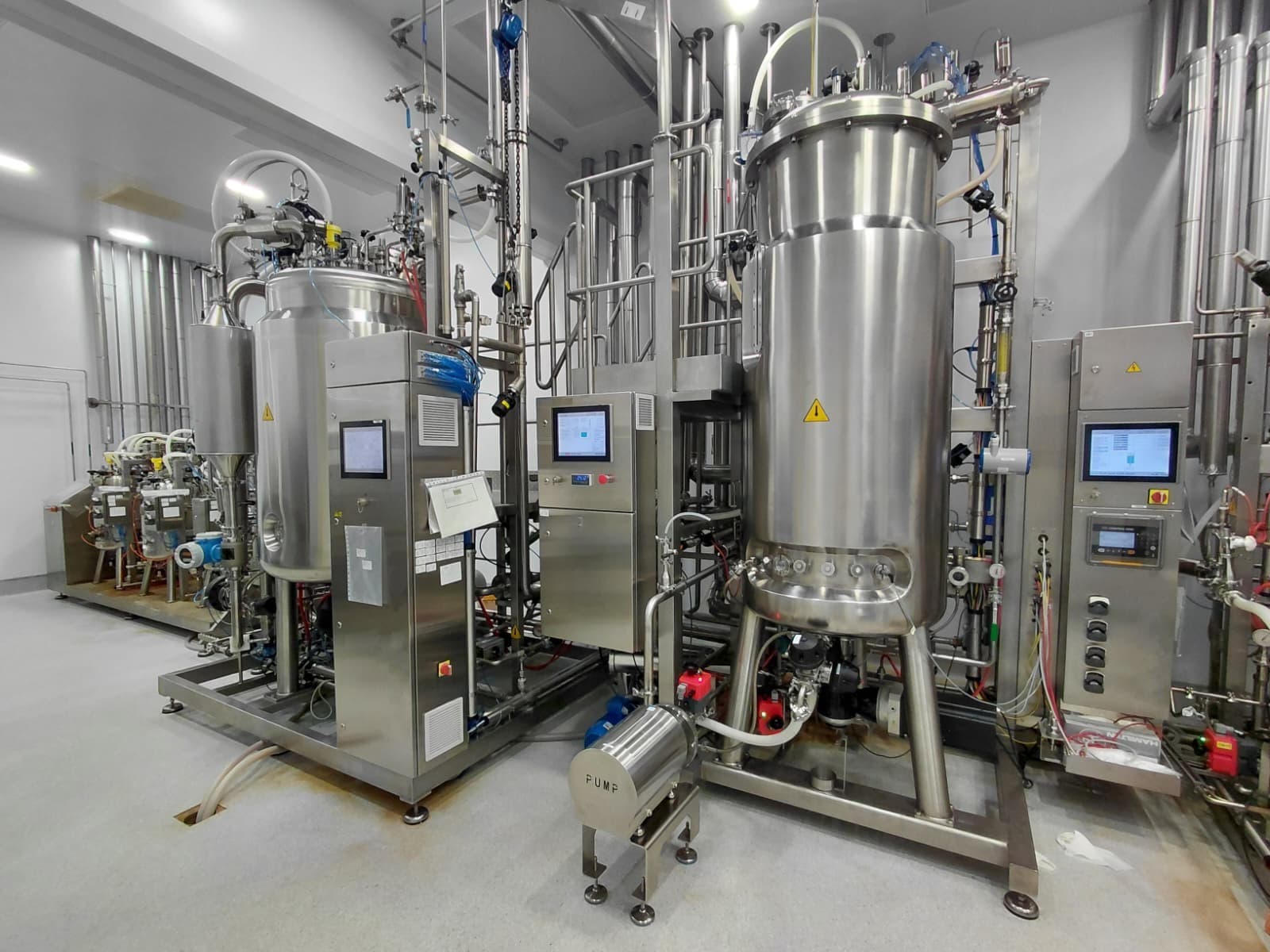
Now follow the money out of the pharmacy. A weekly injectable peptide is hard to make at national scale: fermentation or synthesis capacity, sterile fill-finish lines, hundreds of millions of injector devices. That's not software. That's concrete, stainless steel, cleanrooms, and skilled technicians on multi-year timelines.
Both dominant manufacturers responded with spending that would look at home in a semiconductor cycle. Eli Lilly announced at least $27 billion in new U.S. manufacturing investment in February 2025, including a roughly $9 billion Indiana commitment it called the largest in its history. Novo Nordisk guided to about $9 billion of capacity spending in 2025 and put roughly $4.1 billion into a second fill-finish plant in Clayton, North Carolina.
Trace that chain and you land somewhere unexpected. A gut hormone becomes a pharmaceutical, which becomes a construction boom, which becomes demand for industrial contractors, cleanroom specialists, precision stainless fabrication, and a skilled labor pool the country spent thirty years not training. The GLP-1 story and the American reindustrialization story are, at the seams, the same story.
Then April 2026 changed the geometry. The FDA approved orforglipron, marketed as Foundayo, a once-daily oral GLP-1 with no food or water timing restrictions. In its ATTAIN-1 trial, published in the New England Journal of Medicine, the highest 36 mg dose produced an average weight reduction of about 12.4% at 72 weeks against roughly 0.9% for placebo — real, but below what the strongest injectables deliver. But a small molecule can be made by the ton and shipped without refrigeration, and self-pay pricing started near $149 a month. More users, cheaper delivery, and the pressure lands on whoever writes the check.
Federal deals in 2026 set Medicare pricing near $245 a month for the major injectables and opened obesity coverage with a comorbidity at a $50 copay in July. Employers are the softer link: roughly half of large employer plans cover these drugs for obesity, but a meaningful minority question whether they'll continue. The math is brutal. Pay now for a drug someone may take for years, and capture the savings only if they're still on your plan a decade later. Average job tenure says they won't be.
The ripples spread from there. Industry analyses forecast food-at-home sales falling between 1.1% and 2.7% in 2026 — at least $9 billion, and potentially north of $21 billion a year — as users trade toward protein and smaller packages. In an industry fighting for growth measured in tenths of a percent, that's not a rounding error. Device makers face the inverse question, since bariatric surgery, sleep apnea equipment, and joint replacement all sit partly downstream of obesity prevalence.
Key Judgments
- Oral GLP-1s shift the binding constraint from manufacturing capacity to payer willingness. The fight moves from supply headlines to formulary design.
- Employer coverage is the least stable link, because employers bear the cost and rarely capture the benefit. Coverage fragments by indication rather than expanding uniformly.
- The manufacturing buildout is durable regardless of which molecule wins. Sterile capacity and injector supply serve the broader biologics pipeline.
- Food impact is real but gradual, appearing first in package size and category mix rather than aggregate volume.
Risks & Counterarguments
Discontinuation is the biggest one. Real-world persistence runs far below trial persistence, and weight regain after stopping is well documented. A therapy people quit within a year has very different economics from one they take for life.
Long-term safety data is still accumulating — trials run months to a few years, population-scale use runs decades — and none of this substitutes for individual medical judgment. Adoption estimates also vary widely by survey and method, so precise second-order forecasts are confident guesses. And the competitive picture is unsettled: key patents begin expiring this decade, with several entrants in late-stage development.
Why It Matters
Obesity-related conditions sit upstream of an enormous share of American healthcare spending. A treatment that works at population scale doesn't just change one drug market. It reprices risk assumptions embedded in insurance, food, devices, and federal budgets simultaneously. The last therapeutic class to rearrange this many industries was statins.
What We're Watching
- Persistence and discontinuation rates in pharmacy claims data, especially for oral formulations. This number decides whether the economic case holds.
- Employer coverage decisions for the 2027 plan year in the large annual benefits surveys.
- Medicare uptake and spending under the obesity coverage pathway that began July 2026, in CMS Part D data.
- Food-at-home volume and package-size mix in Census retail data.
Sources: KFF Health Tracking Poll on GLP-1 use; FDA approval documentation and Eli Lilly ATTAIN-1 results for orforglipron; Eli Lilly and Novo Nordisk investor disclosures and SEC filings; Business Group on Health employer surveys; CMS coverage announcements. This is analysis, not investment advice, and nothing here is medical advice.