
Electricity Is the New AI Bottleneck
The AI race quietly became an energy race — and now dead nuclear plants are coming back to life to feed it.
Bottom Line Up Front
For nearly two decades, American electricity demand barely moved. That era is over. AI data centers are the single biggest reason.
The scramble for power has produced something nobody predicted five years ago: shuttered nuclear plants being brought back from the dead, with tech companies signing decades-long contracts for every watt.
The other answer is natural gas — and the companies that build gas turbines are essentially sold out into the next decade. You cannot buy your way to the front of that line.
So the question that decides the AI race is who supplies the electrons, and how fast supply can actually grow. (Land, permits, and grid queues are their own battle — see The Data-Center Land Grab. This report is about generation.)
The honest tension: utilities are planning for enormous demand that is partly real and partly speculative. Build too little and the boom stalls. Build too much and ordinary ratepayers eat the cost.
The flattest line in America
For about twenty years, the most boring chart in American energy was electricity consumption. From the mid-2000s onward it was essentially a flat line. The economy grew, the population grew — and demand didn't budge, because efficiency gains kept soaking up the growth.
Utility planners built their entire world around that flat line. Why build new power plants when demand never rises?
Then the line bent upward. EIA data shows U.S. electricity consumption rising again after more than a decade of stagnation — from a record of roughly 4,100 billion kilowatt-hours in 2024 toward a projected 4,283 billion in 2026, with data centers the dominant driver. In PJM, the giant grid region covering the data-center heartland from Virginia to Chicago, demand is growing more than 3% a year.
Here's why an AI data center breaks the old planning math. A normal city's demand breathes: it peaks on hot afternoons and drops at night. A large AI training facility draws power like a hospital that never sleeps — a flat, relentless, around-the-clock load, sometimes as large as the city itself. It needs what the industry calls firm power: generation that runs whenever you need it, because the sun sets but the training run doesn't. And firm power is exactly what America spent twenty years not building.
Bringing reactors back from the dead
Which explains the strangest development in American energy: the resurrection of nuclear plants that had already been declared dead.
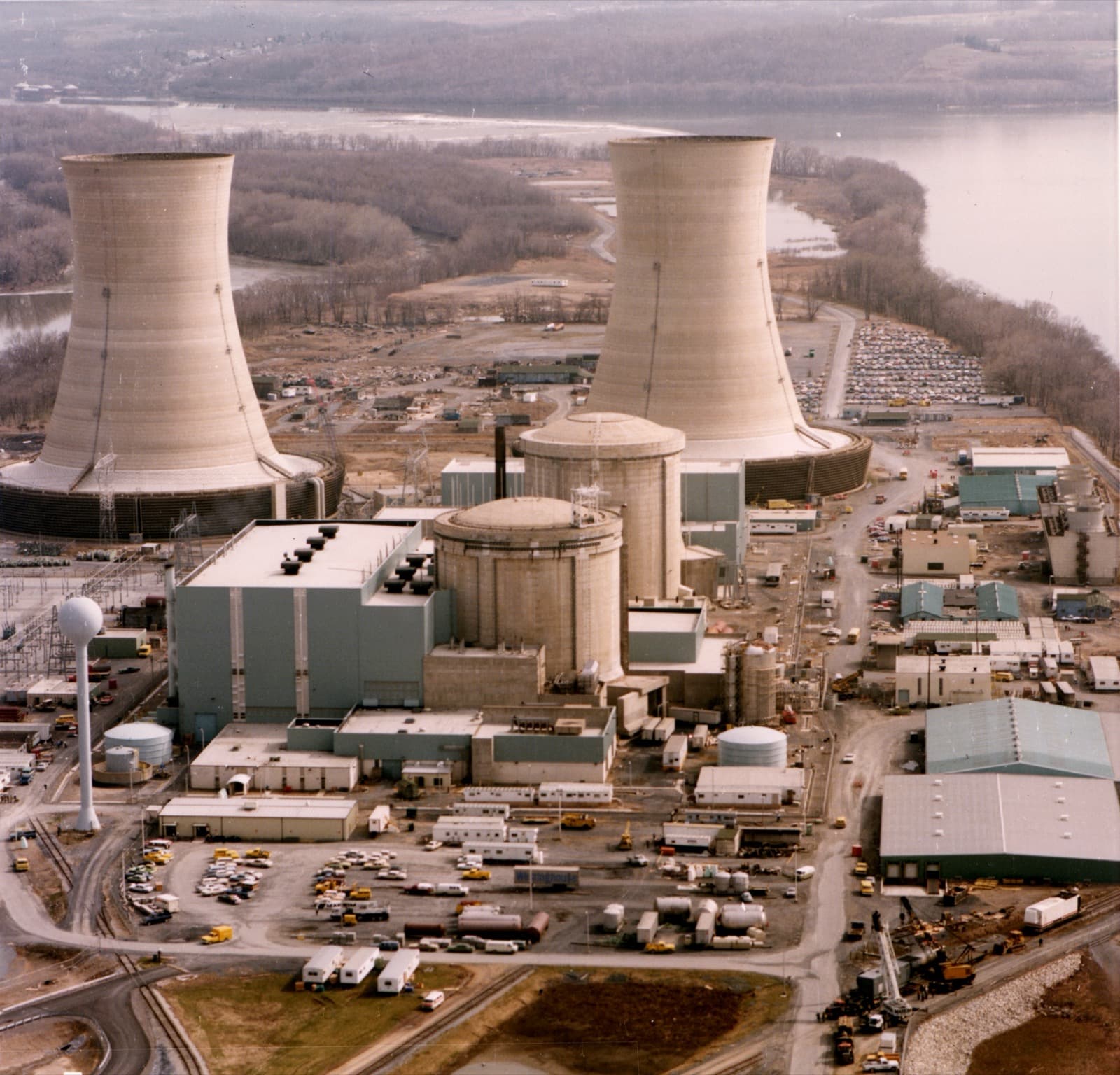
Nobody had ever restarted a shut-down U.S. nuclear plant. Now there's a queue. Palisades in Michigan, closed in 2022, became the first-ever restart, backed by a Department of Energy loan guarantee of up to $1.52 billion. Three Mile Island Unit 1 — renamed the Crane Clean Energy Center — is being revived by Constellation, with Microsoft agreeing to buy its entire 835-megawatt output for twenty years. NextEra and Google struck a deal to restart Iowa's Duane Arnold, targeting the end of the decade.
When a software company signs a twenty-year contract for a nuclear plant's full output, it's telling you two things: it believes compute demand is durable, and it doesn't trust the grid to deliver on its own.
But restarts are one-time tricks — only a handful of closed plants are intact enough to revive. The workhorse answer is natural gas, and that's where the bottleneck bites hardest. GE Vernova, the biggest turbine maker, entered 2026 with a gas-turbine backlog around 100 gigawatts against the ability to build only 10–20 gigawatts a year, and its delivery slots through the end of the decade are nearly spoken for. Order a large turbine today and you're planning a power plant for the 2030s.
Cardinals don't migrate. They survive northern winters on one skill: knowing, before the cold arrives, exactly where reliable food will be every single day. The AI companies signing twenty-year nuclear contracts are doing the same thing — securing a dependable source before winter, while their competitors assume there will always be something at the feeder.
Now trace the chain outward. AI demand pulls on gas turbines, turbines pull on natural gas production, and every megawatt a data center locks up is one someone else's utility must replace — which is how AI ambitions in Virginia end up nudging a family's power bill in Ohio. Regulators are only beginning to fight about who pays.
Key Judgments
- U.S. electricity demand growth is real and durable, not a forecasting blip — but the pace utilities are planning for will prove too high in some regions, because queue requests are partly duplicated and speculative.
- Firm generation is the binding constraint through at least 2030; turbine capacity and nuclear timelines can't expand as fast as announced demand.
- Nuclear restarts and hyperscaler power contracts stay rare and expensive — strategically important, but not enough megawatts to close the gap. Gas fills most of it.
- Consumer electricity prices in data-center-heavy regions rise faster than the national average, making cost allocation a first-tier political fight by 2027.
Risks & Counterarguments
The strongest case against this thesis is efficiency. AI models keep getting cheaper to run per query, and if efficiency outpaces usage growth, projected demand evaporates — utilities would be building plants for phantom load, a mistake ratepayers would fund for decades. The nuclear overbuild of the 1970s was justified by exactly such forecasts.
Data centers may also become more flexible than assumed — shifting workloads off-peak or supplying their own on-site power — easing the crunch faster than turbine backlogs suggest.
Why It Matters
Electricity is the layer where the AI story stops being a tech story. If the electrons arrive on schedule, the buildout continues. If they don't, no amount of capital or silicon substitutes for them. Either way, your power bill is now connected to the AI race — whether you've ever typed a prompt or not.
What We're Watching
- Palisades' operating record and the Crane Clean Energy Center's restart timeline — the test of whether nuclear resurrection is repeatable.
- Turbine delivery schedules at GE Vernova and Siemens Energy. Shortening lead times would signal the constraint easing.
- PJM and Texas capacity auction prices — the cleanest market signal of firm-power scarcity.
- Any hyperscaler canceling or deferring a signed power contract — the earliest sign forecasts were too hot.
Sources: EIA Annual Energy Outlook 2026 and Short-Term Energy Outlook; PJM load forecasts; NRC licensing filings for Palisades and Crane Clean Energy Center; DOE Loan Programs Office disclosures; GE Vernova earnings releases via SEC EDGAR; Constellation and NextEra investor disclosures. This is analysis, not investment advice.